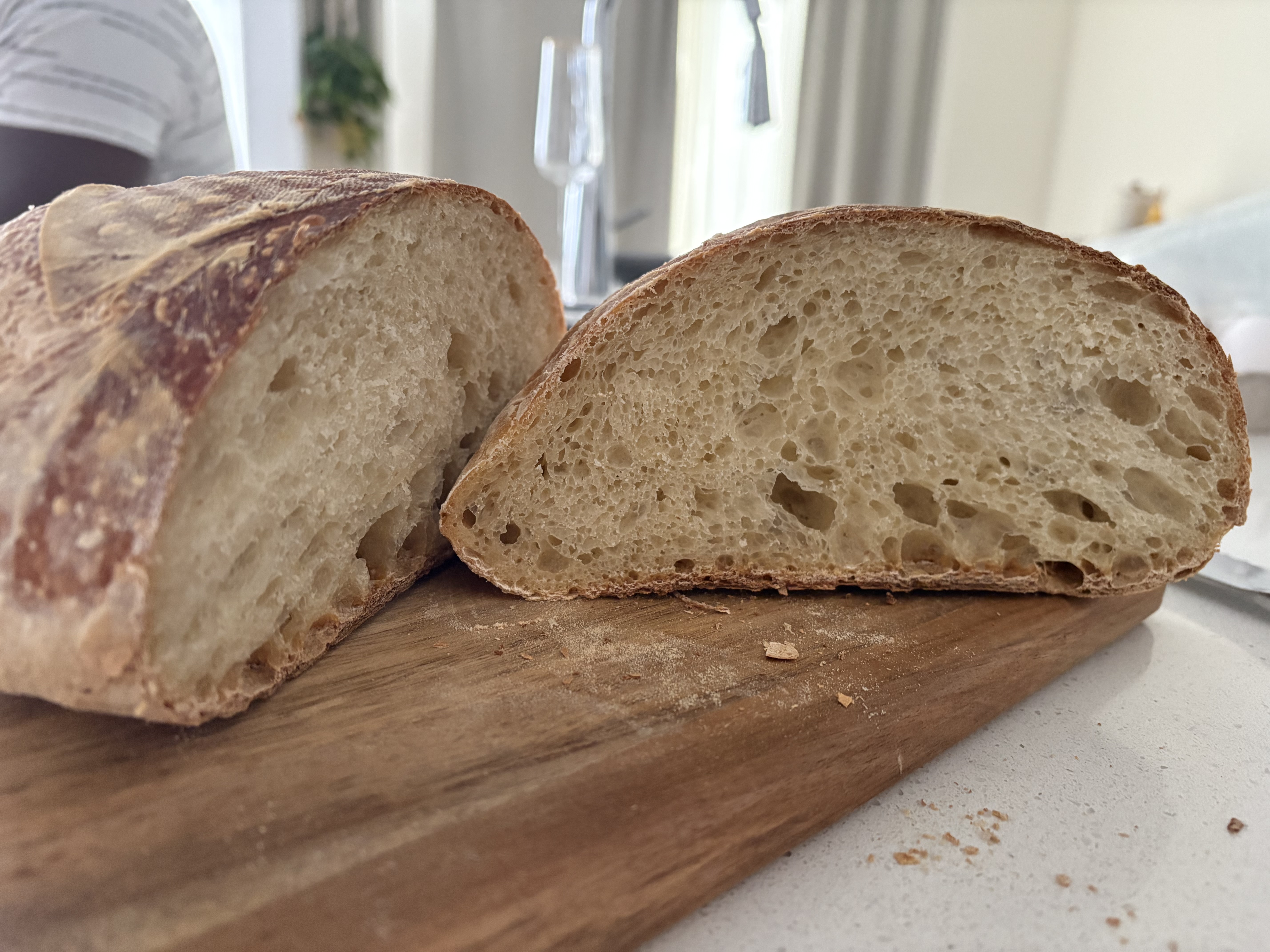

Let’s talk about hydration — the thing that sounds technical and intimidating, but really just means one simple thing:
How much water is in your dough.
That’s it. No need to spiral.
So… What Does Hydration Actually Do?
Hydration changes how your dough feels, behaves, and ultimately how your bread turns out.
- Lower hydration (less water) → firmer dough, easier to handle, tighter crumb
- Higher hydration (more water) → stickier dough, a little wild, but gives you that airy, open crumb everyone loves
If your dough has ever felt like a dream one day and a swamp creature the next… hydration is probably why.
Crumb & Oven Spring (a.k.a. The Glow-Up Phase)
Two of the most satisfying things in sourdough baking:
Crumb = the inside texture of your bread
Oven spring = that beautiful rise your loaf gets in the oven
Higher hydration doughs tend to give you:
- Bigger holes
- Lighter texture
- That “bakery-style” look
But—and here’s the honest part—they’re also trickier to handle. They spread more, stick more, and test your patience just enough to build character.
Lower hydration doughs:
- Hold their shape better
- Are easier to score
- Give a more even, sandwich-friendly crumb
There’s no “better”—just what you’re in the mood for.
The Lid On / Lid Off Situation
If you’re baking in a Dutch oven (and if you’re not, we should talk), this part matters more than you think.
First part: Lid ON
- Traps steam inside
- Keeps the dough soft while it rises
- Helps maximize oven spring
Second part: Lid OFF
- Lets moisture escape
- Develops that deep golden crust
- Adds texture and crunch
Think of it like this:
- Lid on = rise
- Lid off = tan
You need both.
Why Humidity is Your Secret Weapon
Steam is what separates “pretty good” bread from “did you buy this?” bread.
When your dough hits a hot oven, you want moisture in the air so:
- The crust doesn’t set too fast
- The loaf has time to expand
- You get better oven spring and shine
This is why I always put a pan of water on the rack below my Dutch oven.
It’s simple, a little extra, and completely worth it.
That added moisture:
- Boosts your rise
- Improves crust texture
- Gives your loaf that bakery-style finish
No fancy steam injection required. Just water and a little intention.
Keeping It Simple (Because It Should Be)
If all of this still feels like a lot, here’s the stripped-down version:
- More water = more open, airy bread (but messier dough)
- Less water = easier dough, tighter crumb
- Bake with the lid on first, then off
- Add moisture to your oven however you can
That’s the whole game.
Final Thoughts from My Slightly Floured Brain
You don’t need to chase perfection here.
Some days your dough behaves. Some days it absolutely does not. Either way, you’re still making bread from flour, water, and time—which is kind of magic no matter how it turns out.
And honestly? A slightly imperfect loaf with good butter is still a very good decision.
— Kristen

Leave a Reply